
Your memories. On hardware you own.
A personal memory vault for your home.
Software built and verified end to end. Station in development.
Seven parts. One switch.
Built around a Raspberry Pi 5, a four-microphone array, a full-range speaker and a light ring — and a physical switch that cuts power to the microphones. Everything below is the planned V1, drawn to the manufacturers’ own CAD.
AI-rendered from our CAD. Not photographs.
Everything is stored. Nothing is remembered.
Thirty thousand photos. Ten years of messages. A drawer of old drives. You keep all of it, and still cannot find the one thing you need — because storing was solved, and remembering never was.

Lifestyle imagery is AI-generated illustration.
Ask it what no assistant can answer.
ChatGPT has read the internet. Nolaka has read your files — the booking, the policy, the note from the doctor — and answers from them, with the source attached.
Learn how it answers


Found in the booking confirmation you forgot you saved.
Found in the policy PDF, with the date.
Found in the note you typed in the waiting room.
Demo data, shown in the app that runs today.
Built. Verified. Not yet public.
The service, the app and a hosted tier — every user in their own container — are written, tested and walked end to end on a real phone: register, upload, ask, export, delete. About 1,700 automated tests. Not yet deployed, so nobody outside the team can use it.
See what runs today


People and files you keep, drawn as one graph you can pull apart and let settle.
Ask in plain words. The answer cites the files it came from, so you can check it.
If the cloud model is slow or unreachable, the app says so instead of guessing.
Where it lives.
On a side table in the living room, on a shelf in the study, on the counter where the family gathers — a small box that stays out of the way and keeps everything within reach. A box in your living room. Not an account in a data centre.


Living room
AI-generated concept images. No unit has been built.
One vault. Every thread.
Memory is not a pile of files; it is who was there, what happened, and what led to what. Nolaka is designed to keep those threads — person to person, event to event, person to event — and to follow them when you ask. This graph is those threads, drawn.
Drag a node. Click one to read it.
Demo data. Relationship search is on the roadmap; today it matches words in your files.

Whose machine holds your life.
The question of the AI era is not how capable the model is. It is whose machine holds your life.
On a Station, originals stay home: only your question and a few retrieved passages ever leave. On the cloud tier they sit in an encrypted volume, isolated per user. Either way, one export lifts the whole vault out.
-
On a Station, originals stay home.
They will sit on your own SSD. On the cloud tier they sit in an encrypted volume, isolated per user, with nothing shared between accounts.
-
Only retrieved snippets reach the model.
The model sees your question and the few passages needed to answer it. It never sees your library.
-
Export everything, anytime.
One command produces a complete archive of your vault. There is no lock-in to remove, because there is none to build.
AI-generated concept render, built on our CAD.

Off means off.
On the back, one switch will cut power to the microphones. Red means nothing is listening — no software in the loop.
AI-generated concept render, built on our CAD.
Drawn before built.
Every part was modelled against the manufacturers’ own CAD and drawn to production tolerance before anything was ordered — 47 sheets, a 55-item bill of materials, and one cancelled print order when two dimensions turned out to be wrong.
47 sheets, A4. Everything a workshop needs.
Open the drawing set-
Sheet 03 — General arrangement
-
Sheet 04 — Front elevation
-
Sheet 07 — Section A–A
-
Sheet 09 — Exploded assembly
-
Sheet 13 — Cable routing
Production drawings, not renders. Chinese originals — the title block carries our Chinese name, 小满. Dimensions in millimetres.
Small. Quiet. Yours.
A 112 mm square, 185 mm tall. A matte shell over a knit wrap that goes all the way round. Nothing on the front but fabric.
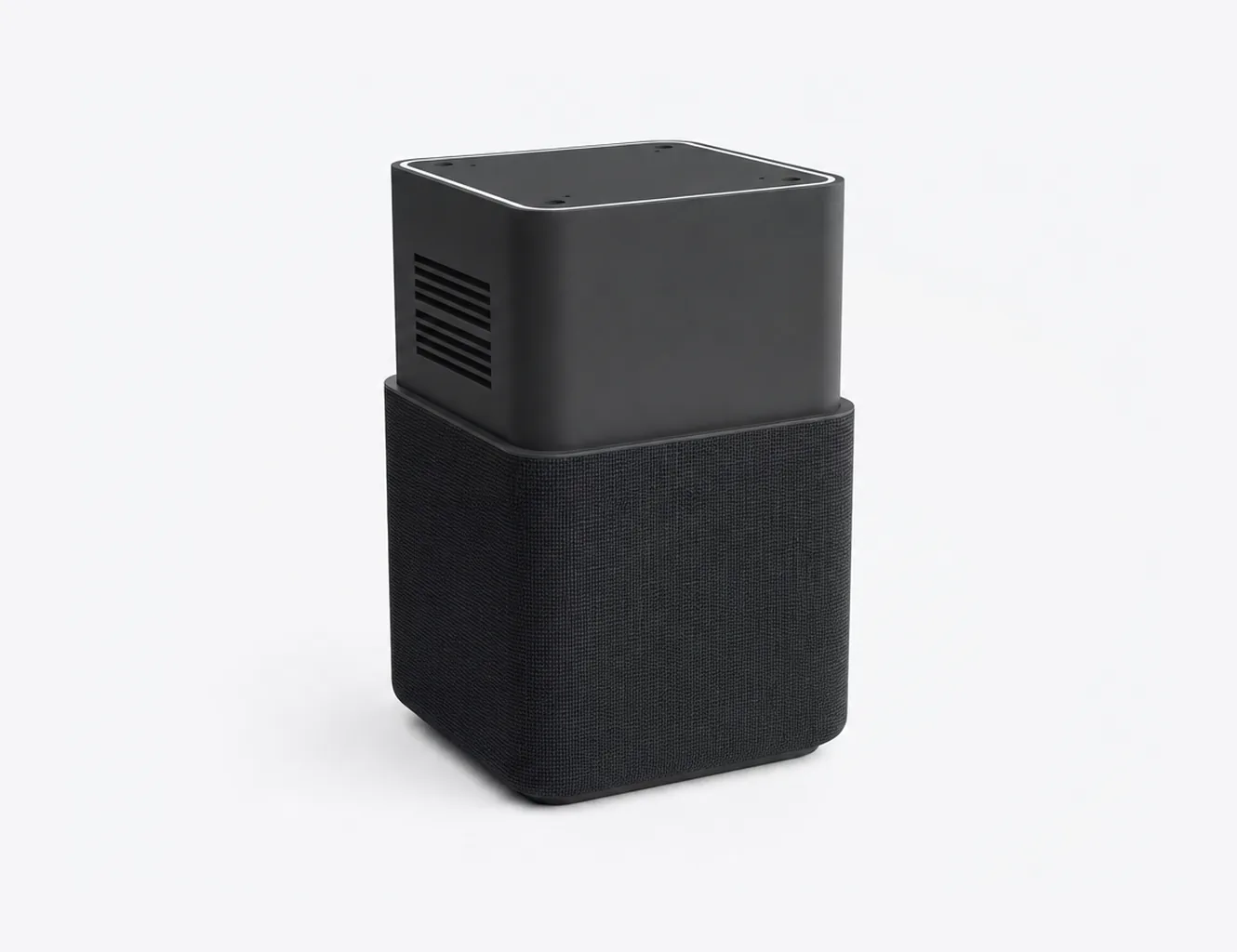
AI-generated concept render, built on our CAD.
Front and back


Front
- Light ring
- Seven states specified, idle to muted.
- Vents
- Airflow in and out, both sides.
Back
- Mute
- Will cut power to the microphones. Red means off.
- USB-C
- Power in. Nothing else out, by design.
- Button
- Pairing and reset. That is all.
Concept renders. Ports and switch are the planned V1.
Wrapped, all the way round.
An acoustic knit wraps the lower half on all four sides, so sound leaves and nothing else gets in the way. Above it, a matte shell. On the back, the one control that matters: a switch that cuts power to the microphones and shows red when it has.


Concept renders. Fabric and switch are the planned V1.
Three, explored.
Charcoal, linen and midnight — concept finishes for the enclosure. V1 will ship in one.
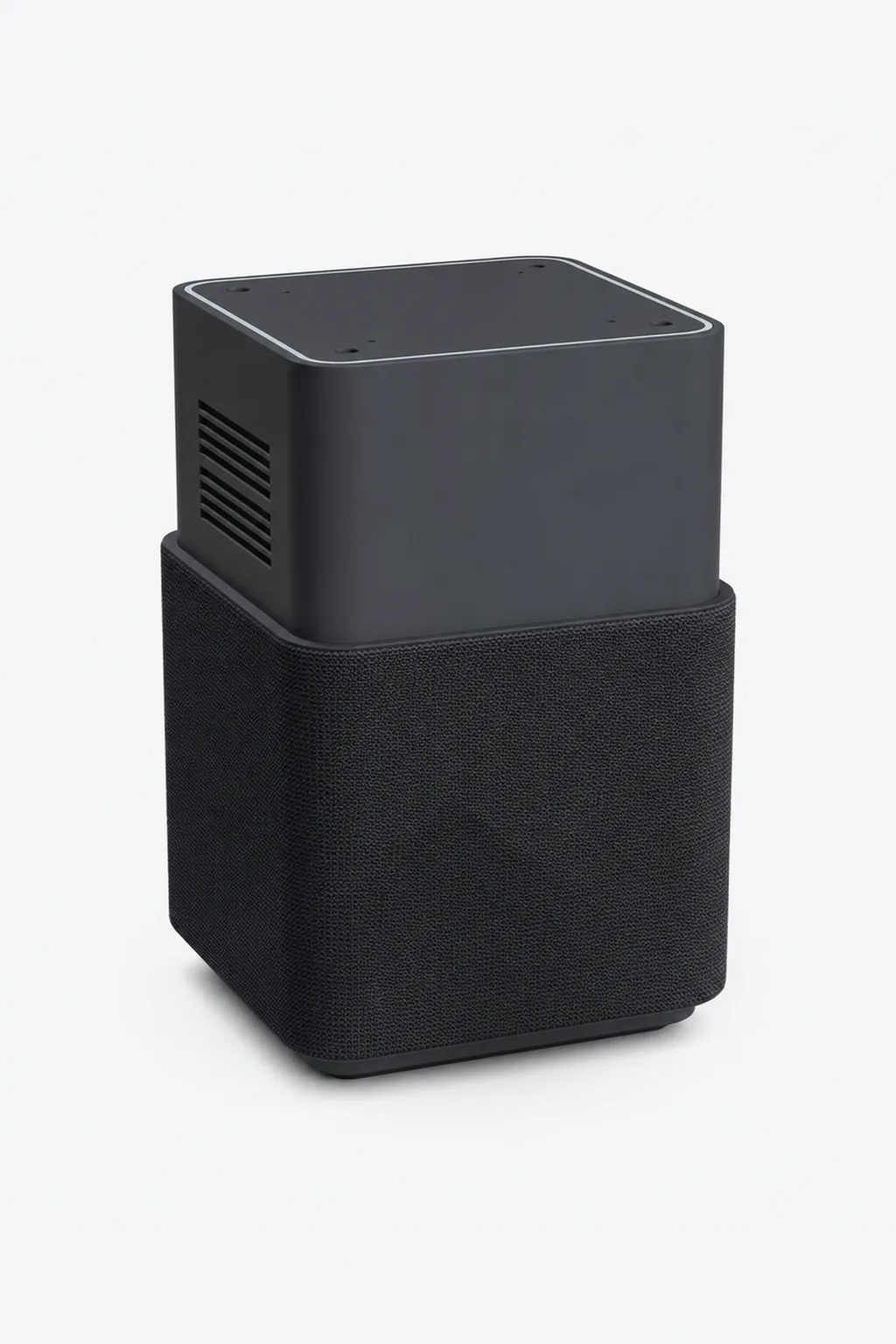
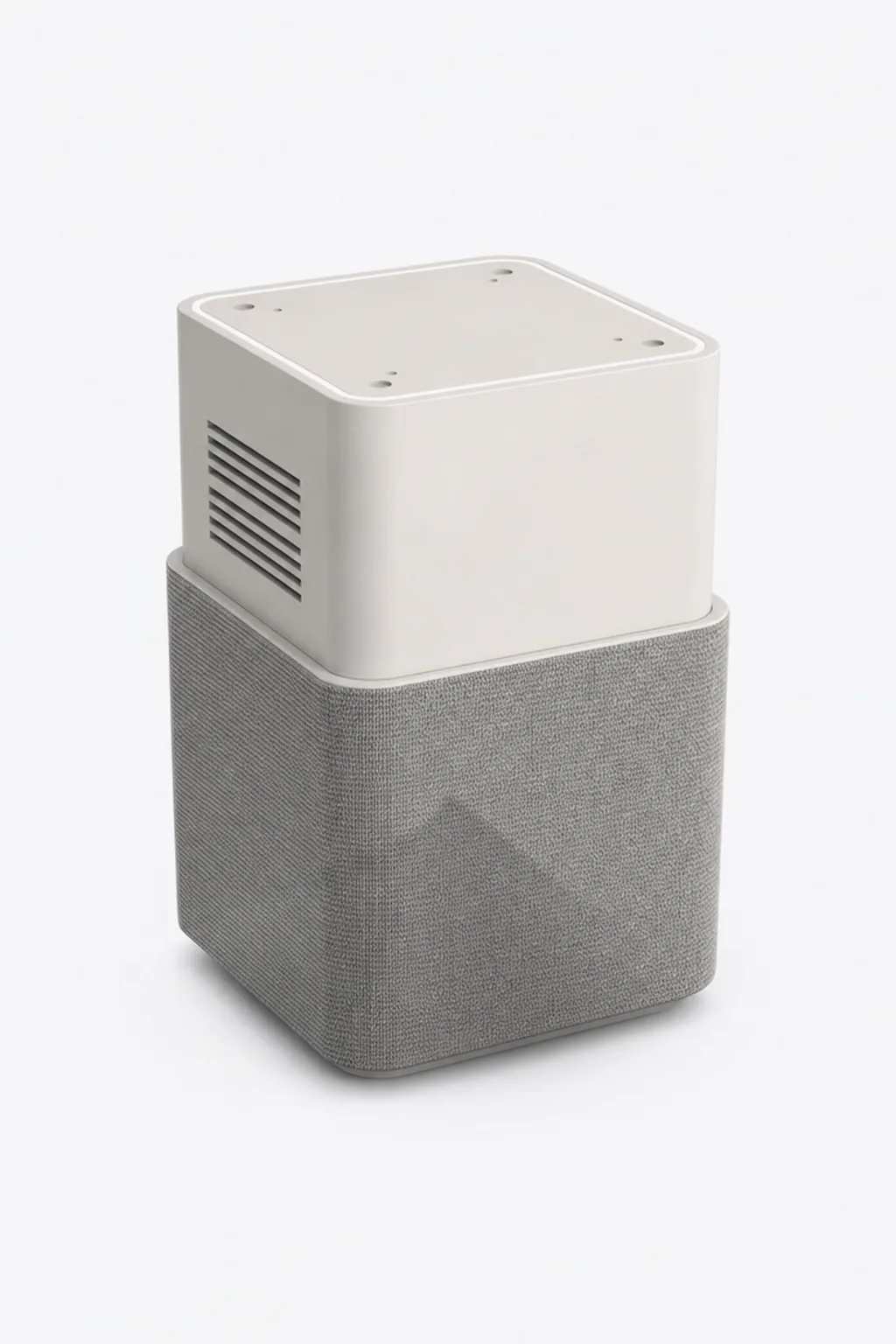
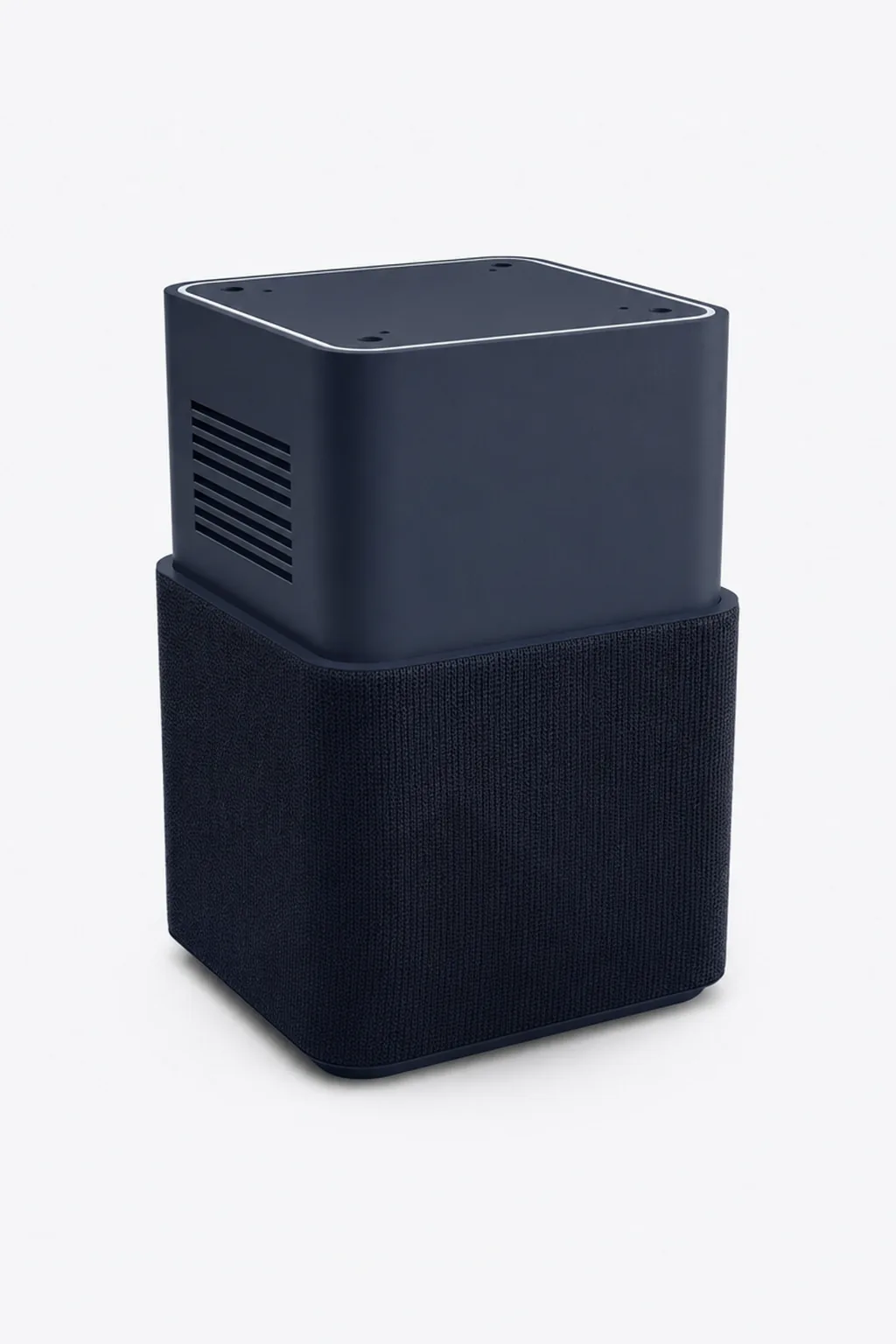
Charcoal
Concept renders. V1 will ship in one.
Start anywhere. End at home.
Begin on your phone with the hosted tier. When you want the archive under your own roof, one export moves everything onto a Station in your living room — once the Station ships.
See the drawings
AI-generated concept image. No unit has been built.
On paper, today.

112 × 112 × 185 mm
Shell size. The acoustic knit adds about 3 mm a side.
1
command. The whole vault leaves in a single archive.
Source-cited
Verified end to end in English and Chinese.
One container per user
Separate storage and separate compute for every account on the cloud tier.
Status
Industrial design complete. Not yet manufactured.
AI-generated concept render, built on our CAD.
Every home will have one.
A private compute and memory center in every household — as ordinary as the router or the fridge. Your family’s data lives there, models reason there, and nothing about your life has to leave the house. The Station is our first step toward that home.
Straight answers.
Including the ones that are not flattering.
What actually runs right now?
Everything is written, tested and walked end to end on a real phone — but nothing is deployed. The hardware is drawings.
Can I buy a Station?
No. Station V1 is an engineering prototype: 47 drawings, a full bill of materials, not one unit built. Nothing is for sale.
Is every hardware image here a render?
Yes — there is nothing to photograph yet. The drawings come straight out of our own CAD; every other hardware image, the exploded view included, is AI-generated on that geometry.
Is it end-to-end encrypted?
No. Your volume is encrypted at rest and isolated per account, but we hold the keys — so we can technically read it.
Is my data used to train models?
We do not, and our providers’ terms say they do not. That is contractual protection, not something we can prove in code.
What happens when I delete my account?
Access is cut immediately and the instance marked for destruction. We cannot promise a deletion deadline until that process exists.
Can I get everything out?
Yes. One command exports the whole vault, walked end to end on a real account. Importing back waits on the Station.
Is the physical microphone switch real?
A real circuit design: a switch in the microphone power path, with an indicator software cannot drive. No device has shipped.
Will I need a Station to use Nolaka?
No. The hosted tier works with nothing plugged in. The Station is where originals go when you would rather hold them yourself.
How good is the search today?
Today it matches the words in filenames and document text, in English and Chinese. Semantic search and photo understanding — finding a picture by what is in it — are on the roadmap, not in the build.
Four weeks from first commit.
My family’s memories live in thirty thousand photos across two phones, three laptops and a drawer of old hard drives. Cloud albums solved storing. Nothing solved remembering.
-
Aug 6
First working iOS prototype. Speak, store a structured memory, ask, get sources back.
-
Aug 14
Product constitution. Station-first architecture, one codebase for home and cloud.
-
Aug 15-18
Retrieval and question answering passing real-cloud acceptance in English and Chinese. Voice-call prototype in the app.
-
Aug 20-21
Cloud version built and verified. Accounts, per-user containers, chunked upload with dedup, quota, backup, one-command export.
-
Aug 25–27
One print order cancelled before it was placed — two dimensions were wrong. The enclosure rebuilt against the manufacturers’ CAD, drawn and costed.
-
Aug 28–Sep 4
The product site, with a complete rendered image set of the device and the production drawings themselves.
One person, with frontier models as the engineering team — me as product owner and reviewer.
Austin Zhang · Founder · Kuala Lumpur